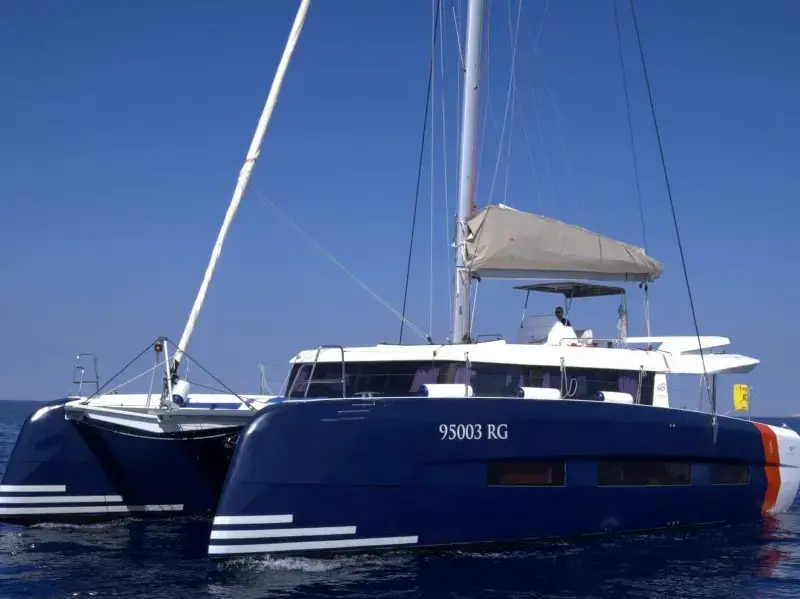
Kvarner: a week from Pula
7 days · 160 nm · starts in Pula · Croatia
Pula
Fly into Pula — the airport is ten minutes from the marina. Handover and provisioning in town. In the evening, the 1st-century amphitheatre, the sixth largest still standing in the world and still a working concert venue.
Pula → Cres
East across the open part of the Kvarner. The town of Cres is a Venetian harbour at the head of a narrow bay with olive terraces around it; Martinšćica bay is worth a stop on the way.
Cres → Krk (Punat)
North through the channel between Cres and Krk. Punat sits in the enclosed bay of Puntarska Draga, all but a lake: one of Croatia's oldest marinas, with the islet of Košljun and its Franciscan monastery in the middle of the bay.
Krk → Rab
Rab is recognisable by its skyline: four Romanesque bell towers in a row above the old town. Berth in the marina or on the town quay; the evening calls for a walk along the three parallel streets of the medieval centre.
Rab → Mali Lošinj
A long leg west across the channel. Mali Lošinj is the deepest natural harbour on the Adriatic and a former resort of the Viennese aristocracy: palms, ochre facades and a waterfront built for steamships.
Mali Lošinj → Brijuni
The longest day, back across the Kvarner. Brijuni is a national park and Tito's former residence: a Roman villa, a safari park descended from the animals he was given, and dinosaur footprints in the rock by the water. Mooring is only at ACI Brijuni and only with a reservation.
Brijuni → Pula
A short final leg, refuelling and handover in Pula.
Northern Croatia is a different Adriatic: fewer islands, but bigger ones, open water between them, and on shore Austro-Hungarian resorts and Roman Pula with an entire amphitheatre instead of Venetian Dalmatia. A loop of about 160 nm with real legs of 25–40 nm — and in July it is noticeably emptier here than around Split.
Practicalities
- Wind: a daytime maestral of 10–18 knots from the north-west in summer. The Kvarner's defining feature is the bora — a cold, squally wind off the mainland, stronger here than anywhere on the Adriatic and quick to arrive. Check the forecast every evening; in a bora the legs to Krk and Rab are cancelled.
- Brijuni is a national park: anchoring anywhere in its waters is prohibited, mooring is only at ACI Marina Brijuni with a booking made in advance, and park admission is paid separately. Without a reservation you cannot get onto the island at all.
- Berths: Kvarner marinas are cheaper than Dalmatian ones, and the quays of Cres, Rab and Mali Lošinj are nearly empty in June and September. The peak is the second half of July and August.
- The legs here are longer than in central Dalmatia, and two days cross open water with no shelter. With beginners aboard the loop is shortened by dropping Rab: Pula — Cres — Krk — Lošinj — Brijuni gives the same islands in 120 nm.
When to go and what it costs
Croatia's best window is spring: a median €150 per person per week — the lowest figure anywhere in our data — and €123 for a last-minute spring booking. Autumn, by contrast, is the most expensive (€262). Year on year Croatia is getting cheaper: −9% per berth in summer.
RYC Rentals data, 2,062 offers from 2024–2026, as of 13 Aug 2026 · full breakdown →